
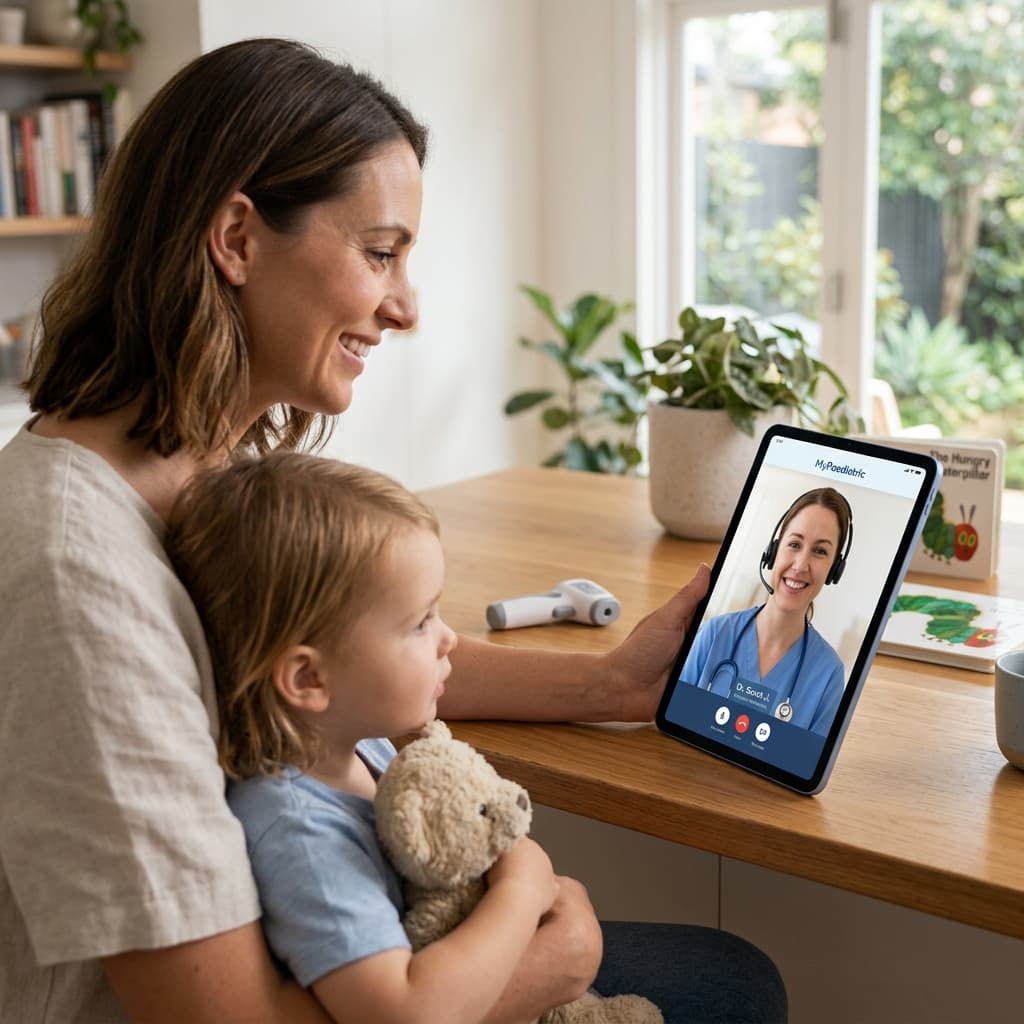
There are few things more stressful for a parent than a sick child in the middle of the night. Trying to decipher whether a sudden fever, a rapidly spreading rash, or a persistent nighttime cough warrants an exhausting trip to a crowded emergency department or if it can wait until morning is a universal parenting dilemma. Compounding this stress are long wait times at traditional medical clinics and the risk of exposing an already vulnerable child to further infections in a waiting room full of sick patients.
Fortunately, the rapid evolution of digital health in Australia has provided a highly effective, safe, and stress-free alternative: paediatric telehealth. An online doctor consultation allows you to connect a registered Australian GP with your sick child from the comfort and safety of your own living room. Whether you need an urgent review of symptoms, a medical certificate for your employer, or a digital prescription sent directly to your nearest late-night pharmacy, telehealth is transforming how families access healthcare.
This comprehensive guide will explore exactly when telehealth is the perfect solution for your child’s health, what common paediatric conditions can be safely treated online, how to prepare for your digital consultation, and most importantly, how to identify the critical "red flag" symptoms that mean you should bypass telehealth and seek immediate emergency care.
Why Australian Parents Are Rapidly Adopting Telehealth
The shift towards telehealth for children isn’t just about convenience; it’s about providing better, safer, and faster care when it is needed most. Here are the primary reasons parents are choosing online doctors over traditional clinics for non-emergency childhood illnesses:
- Immediate Access and Reduced Anxiety: When a child is unwell, waiting days for a standard GP appointment is not an option. Telehealth provides virtually on-demand access to medical professionals, reducing parental anxiety by delivering rapid clinical reassurance.
- Infection Control: Waiting rooms are notoriously high-risk environments for transmitting viral pathogens like influenza, RSV, and Hand, Foot, and Mouth disease. Keeping your child at home ensures they rest in a sterile environment and prevents them from catching secondary illnesses.
- Comfort and Compliance: Children are often fearful of medical clinics, bright lights, and strangers in scrubs. A child in their own environment, perhaps holding their favourite toy or sitting on their own sofa, is far more likely to cooperate with a doctor’s assessment over a video call.
- After-Hours Availability: Children rarely fall ill during convenient 9-to-5 business hours. Fevers often spike in the evening. As detailed in our guide on after-hours telehealth, online GPs provide critical support when local clinics have closed their doors for the night.
What Paediatric Conditions Can Be Safely Treated via Telehealth?
It is a common misconception that all paediatric care requires a hands-on physical examination. In reality, a significant percentage of childhood ailments are highly visual or can be diagnosed through a detailed clinical history provided by the parent. Highly experienced Australian doctors are trained to assess these common paediatric conditions effectively over video or phone consultations.
1. Minor Rashes and Skin Conditions
Children’s skin is highly reactive, and rashes are one of the most common reasons parents seek medical advice. Conditions such as mild eczema flare-ups, nappy rash, suspected ringworm, hives (urticaria) from minor allergic reactions, and mild impetigo (school sores) are highly visible. By uploading clear, well-lit, high-resolution photos prior to or during your telehealth consultation, a doctor can accurately diagnose the issue and issue an online prescription for an appropriate topical steroid, antifungal, or antibiotic cream.
2. Pink Eye (Conjunctivitis)
Conjunctivitis is highly contagious and spreads like wildfire through childcare centres and kindergartens. Symptoms like red, inflamed eyes with a sticky yellow or green discharge are visually unmistakable. Because it is so infectious, keeping your child out of medical waiting rooms is highly recommended. A telehealth GP can quickly confirm the diagnosis via video and issue eScripts for antibiotic eye drops if a bacterial infection is suspected.
3. Mild Upper Respiratory Tract Infections (Colds and Flus)
The vast majority of colds, mild coughs, and sore throats in children are viral. While antibiotics do not treat viruses, parents often need professional advice on symptom management, appropriate paracetamol/ibuprofen dosing based on the child’s exact weight, and guidance on what symptoms to watch out for. An online doctor can provide this rigorous clinical safety netting and peace of mind.
4. Mild Gastrointestinal Issues (Vomiting and Diarrhoea)
A "tummy bug" or mild gastroenteritis is another childcare staple. The primary medical concern with vomiting and diarrhoea is dehydration. During a digital consultation, a doctor will ask specific questions about fluid intake, the frequency of wet nappies or urine output, and assess the child’s general alertness. They can provide a structured oral rehydration plan and advise exactly when hospital intervention might be necessary.
5. Constipation and Feeding Issues
Chronic or acute constipation in toddlers, or mild feeding difficulties in older infants, can often be managed through dietary advice and over-the-counter or prescribed laxative regimes initiated by a telehealth physician.
When to Bypass Telehealth: Red Flag Symptoms for Emergency Care
While telehealth is brilliant for minor ailments, it is entirely inappropriate for medical emergencies. Paediatric patients, particularly infants under 12 months, can deteriorate much faster than adults. If your child exhibits any of the following "red flag" symptoms, do not book a telehealth appointment. You must call 000 immediately or proceed straight to the nearest hospital Emergency Department.
- Respiratory Distress: If your child is struggling to breathe, breathing very rapidly, grunting, wheezing severely, or if the skin around their ribs or neck is "sucking in" (retractions) with each breath.
- Lethargy and Altered Consciousness: If your child is unusually floppy, unresponsive to your voice, impossible to wake up, or unusually confused and irritable.
- Fever in a Young Infant: Any fever (temperature of 38°C or higher) in a baby under 3 months of age is automatically considered a medical emergency and requires immediate hospital investigation to rule out serious infections.
- Non-Blanching Rashes: If your child develops a dark red or purple rash that does not fade or disappear when you press a clear glass against it, this could be a sign of meningococcal disease, which is life-threatening.
- Severe Dehydration: No wet nappies or urine output for over 8-12 hours, no tears when crying, a sunken fontanelle (the soft spot on a baby’s head), or extreme drowsiness.
- Serious Trauma: Suspected broken bones, severe burns, deep lacerations, or any head injury that involves a loss of consciousness or subsequent vomiting.
If you are ever unsure whether your situation is an emergency, err on the side of caution and seek physical emergency medical care immediately.
Getting Carer’s Certificates for School, Childcare, and Work
One of the most practical applications of telehealth for parents is administrative relief. When a child is sent home sick from school or childcare, the parent must inevitably take time off work to care for them. The Fair Work Act in Australia entitles employees to take carer’s leave, but employers almost universally require documentation.
Instead of dragging a sick, crying child to a clinic just to get a piece of paper, you can use a service like Medidoc. Through a quick assessment, an online GP can verify the illness and issue a legally compliant online medical certificate directly to your email. This digital certificate acts as proof for both your employer (confirming your need for carer’s leave) and for the school or childcare centre (confirming the child’s illness and potentially their fitness to eventually return).
Referrals to Paediatric Specialists via Telehealth
Beyond acute sick-day management, telehealth plays a crucial role in long-term developmental care. Navigating the system to get an assessment for neurodevelopmental conditions like Autism Spectrum Disorder (ASD) or Attention Deficit Hyperactivity Disorder (ADHD) requires a specialist paediatrician or child psychiatrist.
To access these specialists—and to claim Medicare rebates for their services—you must first obtain a valid referral from a GP. You can easily book an online specialist referral consultation. The telehealth doctor will take a detailed history of your concerns, document the developmental milestones, and issue an electronic referral letter (valid for 12 months) that you can immediately forward to your chosen specialist paediatric clinic.
Online Prescriptions for Children: What You Need to Know
Anxiety over medication access is common when dealing with telehealth. The short answer is yes: telehealth doctors can and do prescribe medications for children. When a prescription is clinically indicated, the doctor will generate an eScript—a digital QR code token sent via SMS or email to the parent’s phone. This token can be presented at any pharmacy in Australia to dispense the medication.
However, it is vital to understand that Australian doctors adhere to strict antimicrobial stewardship guidelines. Doctors will not prescribe antibiotics for viral infections like the common cold. If antibiotics are requested for issues like ear infections or tonsillitis, the doctor will carefully weigh the risks. In many cases involving deep ear infections (where the eardrum cannot be visualised over video), the telehealth doctor may provide pain management advice but require you to see a physical GP who can use an otoscope before prescribing antibiotics.
How to Prepare for a Paediatric Telehealth Consultation
To get the most accurate diagnosis and the best outcome for your child during a telehealth appointment, preparation is key:
- Gather Data: Before the call, take your child’s temperature using a reliable thermometer and write it down. Note their exact current weight in kilograms, as all paediatric medication dosing is strictly weight-based.
- Take High-Quality Photos: If the issue is a rash, swelling, or eye infection, take photos in bright, natural daylight before the consultation. Video streams can sometimes compress and lose colour accuracy, so static high-resolution photos are invaluable for the doctor.
- Have Medications Ready: Have any current medications, inhalers, or recently used pain relief (like Panadol or Nurofen) ready to show the doctor, including the exact times of the last doses.
- Ensure the Child is Present: While the parent will do the talking, the doctor will almost always ask to see the child on camera to visually assess their breathing effort, skin colour, and general demeanour.
Children's Telehealth vs Adult Condition Guides
Use this article when the patient is a child and you need parent-focused advice about suitability, preparation, certificates, prescriptions, or red flags. Adult condition guides can still help describe symptoms, but children often need lower thresholds for in-person review.
- For children with ear pain, remember that many cases need a physical ear examination. The ear infection telehealth guide explains the limits.
- For vomiting or diarrhoea, use the gastro treatment guide while watching carefully for dehydration.
- For after-hours parent decisions, read the after-hours doctor online guide.
Frequently Asked Questions About Children's Telehealth
Are paediatric telehealth appointments covered by Medicare?
Currently, Australian Medicare rules dictate that to receive a bulk-billed or subsidised telehealth consultation via Medicare, the patient (the child) must have had an in-person, face-to-face consultation at that specific medical practice within the last 12 months. Because on-demand telehealth platforms like Medidoc connect you with doctors who do not have an existing physical clinic relationship with your child, the consultations are purely private and incur an out-of-pocket fee. However, any eScripts generated for PBS-listed medications remain fully subsidised at the pharmacy counter.
Can an online doctor diagnose an ear infection in my child?
Diagnosing a bacterial middle ear infection (otitis media) definitively requires looking inside the ear canal at the tympanic membrane with a specialised medical instrument called an otoscope. Therefore, a telehealth doctor cannot definitively diagnose an ear infection over video. If your child is constantly pulling at their ear and screaming in pain, a telehealth doctor can advise on safe, weight-appropriate pain relief strategies, but they will likely advise you to seek an in-person GP review the following day for a physical ear exam before prescribing antibiotics.
Can I get a repeat prescription for my child’s asthma inhaler?
Yes. If your child has an existing diagnosis of asthma and you simply need a repeat of their preventer or reliever medication, this is highly suitable for telehealth. You can review our detailed guide on asthma telehealth management to understand exactly what evidence you need to provide (such as a photo of the previous pharmacy label) to secure a rapid eScript refill.
Is there a minimum age for telehealth consultations?
Telehealth can be utilised for patients of any age, including newborns. However, the threshold for referring infants under 6 months—and strictly under 3 months—to a physical Emergency Department is exceptionally low due to the rapid rate at which neonates can deteriorate and the subtle nature of their clinical signs.
Bringing Peace of Mind Back to Parenting
Parenting is challenging enough without navigating a congested healthcare system every time your child catches a daycare bug. By understanding the capabilities and limitations of digital health, you can make informed decisions that save time, reduce stress, and keep your child comfortable at home while still receiving expert, registered Australian medical care.
Next time your little one is unwell in the middle of the night, don’t panic. Book a telehealth consultation with Medidoc and get the professional guidance you need instantly.