
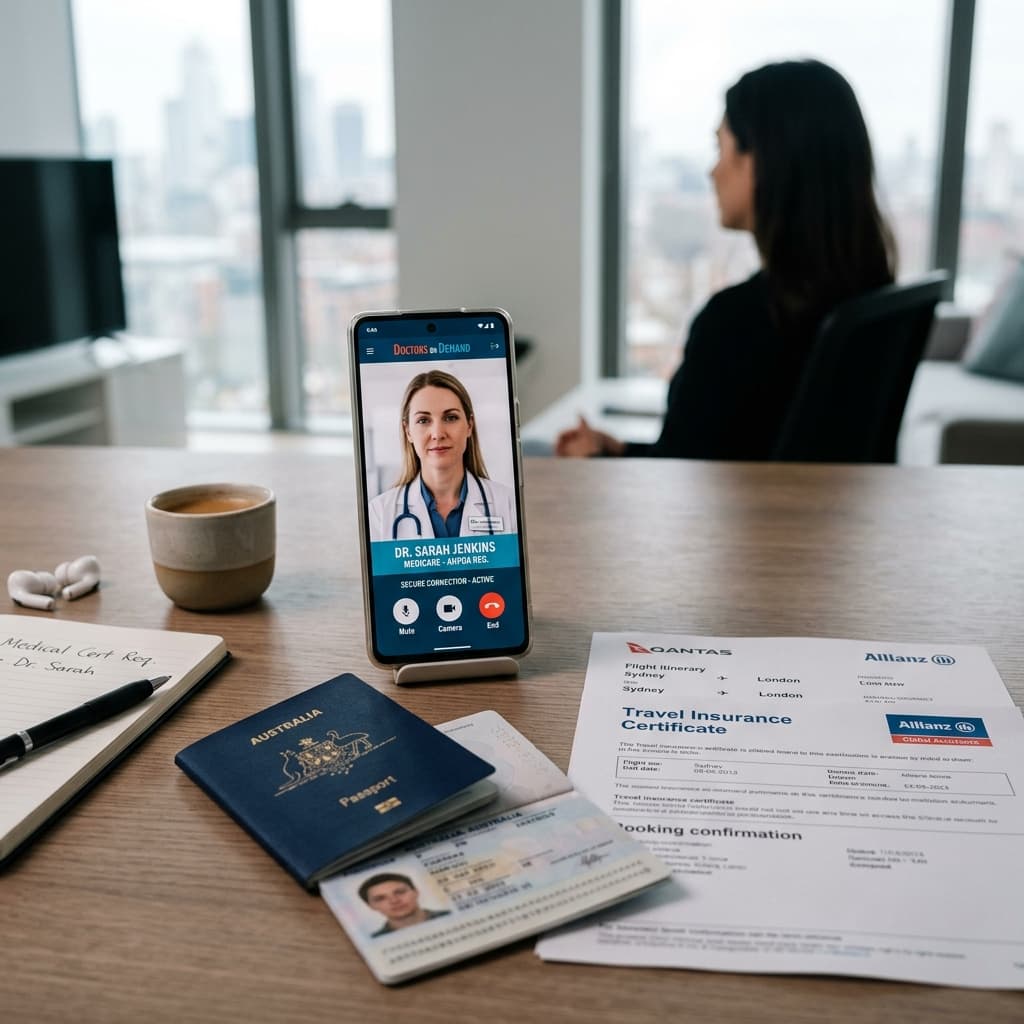
Getting sick while you are overseas can be stressful enough without worrying about work, study, or leave paperwork back home. If you are an Australian employee travelling abroad, you may wonder whether you can still get a medical certificate, whether your employer has to accept overseas evidence, and whether an online doctor can help.
This guide explains how medical certificates while overseas usually work for Australian workers, what evidence employers may ask for, when telehealth medical certificates may be appropriate, and why country-specific rules matter if you are outside Australia.
Can You Get a Medical Certificate While Overseas?
In many cases, yes. The practical question is not simply whether you are overseas, but whether the evidence shows that you were genuinely unable to work because of illness or injury. In Australia, employers can ask for evidence for sick or carer leave, and the evidence needs to be reasonable in the circumstances.
That means an employee who becomes unwell overseas should think about two things: getting appropriate medical care where they are, and keeping clear documentation that explains the dates and fitness-for-work issue. A certificate from an overseas doctor, hospital, clinic, or telehealth provider may be useful, but acceptance can depend on the employer, the workplace policy, and the details on the document.
What Australian Employers Usually Need to See
Australian employers are generally looking for evidence that would convince a reasonable person that you were entitled to take sick or carer leave. The exact document can vary, but useful evidence usually includes:
- Your name and the date of the consultation or assessment
- The date or dates you were unfit for work or study
- A clear statement that you were unable to work because of illness or injury
- The name, role, and contact details of the clinician or service
- A signature, provider details, or another way for the document to be verified
- Translation or clarification if the document is not in English
A certificate does not usually need to disclose your private diagnosis unless you choose to share it. Many certificates simply state that you were unfit for work for a specified period.
Does the Certificate Need to Be From an Australian Doctor?
Not always. If you are overseas, it may be reasonable to see a local doctor or hospital in the country you are visiting, especially if you need urgent or in-person care. However, if your employer specifically requires certain evidence, or your condition can be safely assessed remotely, an Australian telehealth doctor may be able to help you understand your options.
For Australian employment matters, the key issue is whether the evidence is credible, relevant to the dates of leave, and reasonable in the circumstances. If you are unsure, check your workplace policy or contact your employer as soon as practical to confirm what evidence they expect.
When an Online Medical Certificate May Be Appropriate
Telehealth can be useful when your symptoms are suitable for remote assessment. For example, an Australian online doctor may be able to assess some short-term illnesses, recurring conditions, medication issues, or common symptoms by video or phone, then decide whether a certificate is clinically justified.
A Medidoc consultation may be suitable if:
- You are overseas but need advice from an Australian-registered doctor
- Your symptoms do not require urgent emergency care or a physical examination
- You need a certificate for an Australian employer, university, or organisation
- You need help deciding whether local in-person care is safer
- You need documentation for a short period of illness while travelling
If your symptoms are severe, unusual, or unsafe to assess remotely, the doctor may advise you to seek local urgent care instead. That is especially important overseas, where travel, dehydration, unfamiliar infections, and limited support can make illness more complicated.
What If You Are Based in Another Country?
Medical certificate and sick note rules are country-specific. Australian advice is most relevant when the certificate is for an Australian workplace or institution. If you are living or working in another country, local employment rules and employer expectations may be different.
For example, UK employees often deal with fit notes and self-certification rules rather than Australian-style sick leave evidence. If you are in the UK, a UK-focused medical certificate provider such as DoctorCert may be more relevant than an Australian telehealth certificate because the documentation context is different.
The safest approach is to match the certificate to the country, employer, and purpose. A document designed for one workplace system may not be the best fit for another.
What To Do If You Get Sick Overseas
- Tell your employer or university as soon as practical and estimate how long you may be away
- Check your workplace or course policy for evidence requirements
- Seek urgent local care if symptoms are serious, worsening, or travel-related
- Keep copies of clinic documents, receipts, prescriptions, discharge summaries, and certificates
- Ask for an English version or translation if the certificate is in another language
- Book a telehealth consultation if your symptoms are suitable and you need Australian medical advice
If your illness affects flights, accommodation, insurance, or travel plans, you may also need separate documentation for your insurer or airline. That is different from a work medical certificate, so ask the relevant organisation what they require. For Australian work leave basics, our online medical certificate guide explains how standard certificate evidence works.
When You Should Seek Local Urgent Care
Do not rely on an online certificate if you need urgent medical attention. Get local emergency care if you have:
- Chest pain, severe shortness of breath, fainting, or stroke-like symptoms
- Severe allergic reaction, swelling of the face or throat, or trouble breathing
- High fever with confusion, neck stiffness, rash, or severe weakness
- Severe abdominal pain, persistent vomiting, or signs of dehydration
- Serious injury, suspected fracture, head injury, or heavy bleeding
- Symptoms after an animal bite, contaminated food or water exposure, or travel-related infection risk
When in doubt, seek local medical care first. A certificate is secondary to getting the right treatment. If you are unsure whether symptoms are urgent, our emergency department vs GP guide can help you think through escalation, but overseas emergencies should be handled through local emergency services.
Can a Certificate Be Backdated If You Were Sick Overseas?
A doctor cannot simply certify something they did not assess. However, a doctor may sometimes issue a certificate that covers a recent period of illness based on your history, timing, symptoms, and supporting evidence. This depends on the clinical situation and the doctor's judgement.
If you saw a local doctor overseas, keep that documentation. It may help an Australian doctor understand the timeline, but it does not guarantee that a new certificate can be issued for past dates.
Will an Employer Accept an Overseas Medical Certificate?
Many employers will accept credible overseas evidence if it clearly explains that you were unfit for work and covers the relevant dates. But employers can have different policies, and some may ask for additional information if the document is unclear, untranslated, missing dates, or hard to verify.
If your employer questions the certificate, ask what specific information they need. Often the issue is not that the certificate was issued overseas, but that it does not clearly show the period of incapacity or the clinician details.
Medical Certificate Overseas vs Standard Online Certificate
This article is intentionally focused on the overseas scenario. If you are in Australia and simply need a certificate for work, university, school, or carer leave, the main online medical certificate page is the better place to start. If you need a full appointment rather than certificate-only guidance, see our online consultation page. If you are unwell with a specific symptom, one of our condition guides may also help you decide whether telehealth is appropriate.
- Use the medical certificate page for straightforward Australian certificate requests
- Use the online consultation page if you need broader medical advice
- Use the emergency vs GP guide if you are unsure whether symptoms are urgent
- Use condition-specific guides for migraine, gastro, cold and flu, sinus symptoms, period pain, or UTI symptoms
Frequently Asked Questions
Can I get an Australian medical certificate while overseas?
Sometimes. If your symptoms are suitable for telehealth, an Australian-registered doctor may be able to assess you remotely and decide whether a certificate is clinically appropriate. If you need urgent or hands-on care, you should see a local doctor instead.
Can my employer reject a medical certificate from overseas?
An employer may question evidence if it is unclear, incomplete, not translated, or does not show that you were unfit for work. If this happens, ask what specific information they need and whether additional supporting documents would help.
Do I need to tell my employer while I am still overseas?
Yes. You should notify your employer as soon as practical and tell them how long you expect to be away if you can. Notice can sometimes be given after leave starts, but delaying without a good reason can create problems.
Can I use a hospital discharge summary instead of a certificate?
It may help, especially if it shows dates, treatment, and the reason you were unable to work. Some employers may still ask for a formal certificate or clearer fitness-for-work statement.
What if my certificate is not in English?
Ask whether the clinic can provide an English version. If not, your employer may ask for a translation or additional evidence so they can understand the dates and fitness-for-work statement.
Need a Medical Certificate While Overseas?
If your symptoms are suitable for telehealth and you need Australian medical advice or documentation, book an online consultation with Medidoc. A doctor can assess your situation and help you decide the safest next step.