
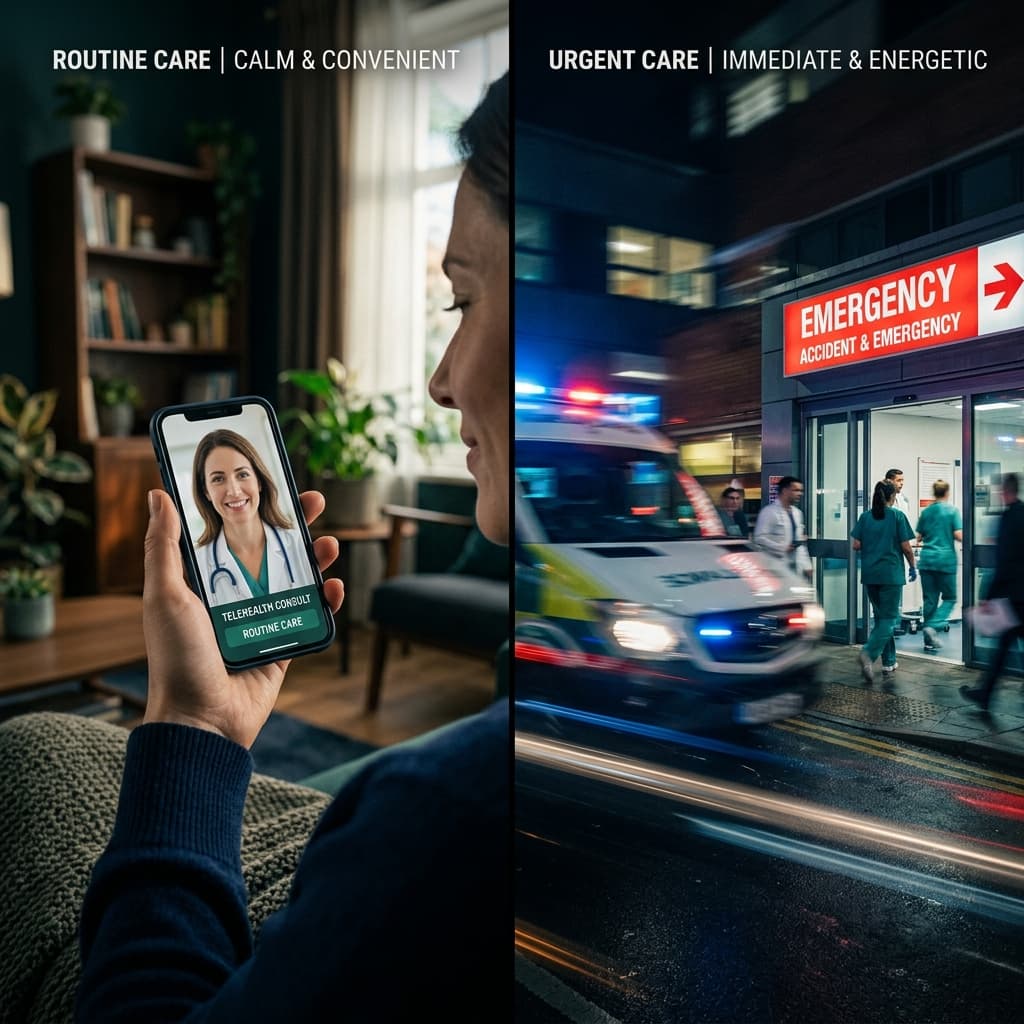
It is 11pm on a Saturday night and you are not feeling well. Maybe it is a sharp pain in your chest. Maybe your child has a high fever. Maybe you have cut yourself and it will not stop bleeding. The question races through your mind - should I go to the emergency department, or can this wait for a GP?
Making the wrong call can mean either an unnecessary 6-hour wait in an overcrowded ED, or a dangerous delay in getting critical treatment. This guide will help you understand when to go to the emergency department, when a GP (or telehealth doctor) is the right choice, and what your other options are in Australia.
When to Call 000 - Life-Threatening Emergencies
Call 000 immediately if someone is experiencing any of the following. Do not drive yourself - wait for an ambulance.
- Chest pain, tightness, or pressure - especially if spreading to the arm, jaw, or back
- Difficulty breathing or shortness of breath that is getting worse
- Signs of stroke - face drooping, arm weakness, speech difficulty (remember FAST)
- Severe allergic reaction (anaphylaxis) - swelling of the face/throat, difficulty breathing, collapse
- Loss of consciousness or unresponsiveness
- Severe bleeding that cannot be controlled with direct pressure
- Seizures (especially first-time seizures or seizures lasting more than 5 minutes)
- Suspected spinal injury - do not move the person
- Severe burns covering a large area of the body
- Overdose or poisoning
Do not hesitate to call 000 if you are unsure. It is always better to call and not need it than to delay when seconds matter.
When to Go to the Emergency Department
Emergency departments are designed for conditions that are urgent, potentially life-threatening, or require immediate specialist intervention. Go to the ED for:
Serious Injuries
- Suspected broken bones (especially if the limb is deformed or you cannot move it)
- Deep cuts or wounds that may need stitches
- Head injuries with loss of consciousness, confusion, or vomiting
- Eye injuries involving chemicals or penetrating objects
- Significant falls, especially in elderly people
Severe or Sudden Symptoms
- Sudden, severe headache (worst headache of your life) - could indicate brain haemorrhage
- Sudden vision loss or double vision
- Severe abdominal pain that is getting worse
- Coughing or vomiting blood
- High fever with stiff neck and sensitivity to light (possible meningitis)
- Severe dehydration - unable to keep fluids down, dizziness, no urine output
Children - When to Go to ED
- Difficulty breathing or breathing very fast
- Fever in a baby under 3 months old
- Child is unusually drowsy, floppy, or difficult to wake
- Not feeding or drinking for more than 8 hours
- Rash that does not fade when pressed (possible meningococcal)
- Seizures or convulsions
When a GP or Telehealth Doctor Is the Right Choice
Many conditions feel urgent but are not emergencies. Seeing a GP - either in person or via telehealth - is the right choice for most non-life-threatening health concerns.
Common GP Conditions
- Cold, flu, cough, and sore throat
- Ear infections and sinus infections
- Urinary tract infections (UTIs)
- Skin rashes, mild allergic reactions, and insect bites
- Back pain, muscle strains, and joint pain
- Eye infections (conjunctivitis)
- Mild to moderate gastro (vomiting and diarrhoea)
- Mental health concerns - anxiety, depression, stress
- Prescription refills and medication reviews
- Medical certificates for work or study
- Referrals to specialists
When Telehealth Is Ideal
Telehealth consultations are especially suited for situations where:
- You need a quick assessment of mild to moderate symptoms
- You need a prescription refill or new script
- You need a medical certificate
- It is after hours and your GP clinic is closed
- You are in a rural or remote area
- You cannot leave home due to illness, disability, or caring responsibilities
- You want a private consultation for sensitive health issues
The Grey Area - When You Are Not Sure
Some situations fall in between and can be difficult to judge. Here is how to handle common grey-area scenarios:
Fever
GP/Telehealth: Mild to moderate fever (under 39C) in an otherwise healthy adult, responding to paracetamol.
ED: Fever above 39C not responding to medication, especially with stiff neck, confusion, or rash. Any fever in a baby under 3 months.
Abdominal Pain
GP/Telehealth: Mild to moderate stomach pain, bloating, constipation, or known IBS symptoms.
ED: Sudden, severe abdominal pain. Pain that is getting worse over hours. Pain with fever, vomiting blood, or inability to pass gas.
Chest Pain
GP/Telehealth: Mild, brief chest pain that you can reproduce by pressing on the area (likely muscular). Known reflux or anxiety-related chest tightness.
ED/000: Any new, unexplained chest pain. Pain with shortness of breath, sweating, nausea, or pain radiating to arm or jaw. Always err on the side of caution with chest pain.
Cuts and Wounds
GP: Small cuts that have stopped bleeding, minor burns, insect bites, infected wounds.
ED: Deep cuts that will not stop bleeding, wounds exposing bone or tendon, animal bites to the face or hands, large burns.
Mental Health Crisis
GP/Telehealth: Ongoing anxiety, depression, or stress that is affecting daily life.
ED/000: Suicidal thoughts with a plan, self-harm requiring medical treatment, psychosis. You can also call Lifeline on 13 11 14 or Beyond Blue on 1300 22 4636.
What to Expect at the Emergency Department
If you do go to the ED, here is what to expect:
- Triage - a nurse will assess how urgent your condition is and assign a priority category (1 = resuscitation, 5 = non-urgent)
- Wait - patients are seen based on urgency, not arrival time. Non-urgent cases may wait several hours
- Assessment - a doctor will examine you, order tests, and determine treatment
- Treatment - this may include medication, procedures, imaging, or admission to hospital
- Discharge - you will receive discharge instructions and may be told to follow up with your GP
Important: Going to the ED for non-urgent conditions does not mean you will be seen faster. You may wait 4-8 hours for conditions that a GP could treat in 15 minutes.
Other Options Beyond ED and GP
Australia has several healthcare options between a GP and the emergency department:
- Healthdirect helpline (1800 022 222) - free 24/7 health advice from registered nurses who can help you decide where to go
- After-hours GP clinics - some areas have GP clinics open in the evenings and weekends
- Pharmacy - pharmacists can provide advice and over-the-counter treatment for minor conditions
- Telehealth - see an online doctor 7 days a week for non-emergency conditions
- Urgent care clinics - available in some states for conditions that need same-day attention but are not emergencies
Cost Comparison
Understanding the cost difference can help inform your decision:
- Emergency department - free for Medicare card holders, but designed for emergencies. Non-urgent visits strain the system and result in long waits
- GP clinic - standard consultation fees apply (some bulk-bill). Typically $40-90 for a standard appointment
- Telehealth - affordable consultations, often lower cost than in-person GP visits. Available outside business hours
- Ambulance - costs vary by state. In Queensland ambulance is free. In other states, costs can exceed $1,000 without cover
How Medidoc Can Help
For non-emergency health concerns, Medidoc telehealth offers a fast, convenient alternative to waiting rooms:
- See a registered Australian doctor in minutes
- Available 7 days a week with extended hours - including after-hours when GP clinics are closed
- Get prescriptions, medical certificates, referrals, and pathology requests
- Ideal for after-hours care when you are unsure if a condition needs the ED
- A telehealth doctor can also help you decide if you need to go to the ED
Condition Guides for Common Grey-Area Symptoms
If vomiting or diarrhoea are the main issue and the key question is dehydration risk, start with our gastro treatment guide.
If you are dealing with a red sticky eye and are unsure whether it is pink eye or something more serious, see our conjunctivitis guide.
If ear pain or swimmer's ear symptoms are the issue, read our ear infection guide for telehealth limits and escalation advice.
What Urgent Care, After-Hours GP, and Telehealth Each Cover
Many patients are not choosing only between an emergency department and a daytime GP appointment. In Australia, the real decision may involve urgent care, an after-hours GP, or telehealth first. Knowing what each option covers helps you escalate faster and avoid sitting in the wrong queue.
Urgent care or after-hours GP may fit when
- You probably need a physical examination soon, but the situation does not sound like a 000 emergency, such as worsening ear pain, a throat infection with trouble swallowing fluids, or an injury that may need hands-on assessment.
- You are unwell outside usual clinic hours and the key issue is access to an examination rather than only advice.
Telehealth can still be useful when
- You need fast triage for a non-urgent symptom and want to understand whether home care, an in-person clinic, or escalation is the next safest step.
- You need follow-up support for results, a repeat prescription, or a medical certificate where the problem can be assessed well by history.
- You are comparing late-night or weekend care options and want the broader context from the after-hours doctor online guide.
Go straight to emergency care or call 000 when
- There is chest pain, severe breathing trouble, stroke symptoms, major trauma, severe allergic reaction, or rapidly worsening collapse.
- The risk is time-critical enough that a routine GP or telehealth booking would create unsafe delay.
Frequently Asked Questions
Should I go to the emergency department for a UTI?
In most cases, no. UTIs are best treated by a GP or telehealth doctor who can prescribe antibiotics quickly. However, if you have a high fever, severe back pain, or are vomiting, the infection may have spread to your kidneys and you should go to the ED.
Can I go to the ED for a prescription refill?
Emergency departments are not designed for prescription refills. For repeat scripts, see your GP or use a telehealth service to get an eScript sent to your phone. This is faster and frees up ED resources for genuine emergencies.
What if my GP is closed and I need medical help?
Options include telehealth (available 7 days a week), after-hours GP clinics, Healthdirect (1800 022 222) for phone advice, or your local pharmacy for minor issues. Only go to the ED if your condition is urgent or potentially life-threatening.
How do I know if chest pain is serious?
Chest pain should always be taken seriously. If the pain is new, severe, or accompanied by shortness of breath, sweating, nausea, or pain spreading to your arm or jaw, call 000 immediately. If you have had similar pain before and it is mild, reproducible by pressing, and related to a known condition like reflux, a GP or telehealth consultation may be appropriate.
Is it worth going to the ED for a broken bone?
Yes, if you suspect a fracture - especially if the limb is deformed, you cannot bear weight, or there is significant swelling. The ED has X-ray and specialist orthopaedic services available. For minor sprains and strains, a GP can often assess and manage the injury.
Not Sure If You Need the ED? Talk to a Doctor First
If you are unsure whether your symptoms require emergency care, a telehealth consultation with Medidoc can help you make the right decision. Our doctors can assess your condition, provide treatment for non-emergency issues, or advise you to go to the ED if needed - all within minutes.